 Japan
Japan Korea
Korea China
China

The Rise of Laser Facial Hair Removal in Male Patients
Is Your Practice Ready?
Male patients are now one of the fastest-growing demographics in medical aesthetics, and laser facial hair removal is one of the treatments leading that growth. For practices already offering hair removal services, this is a patient segment actively seeking out what you have. For practices that have not yet positioned their services toward men, the opportunity is accessible now.
This post covers what is driving male patient demand, what practitioners need to know about treating the male face, how to reach this patient group, and how the Gentle Pro™ Series supports facial laser hair removal across the full range of male skin types.
Key Takeaways
- Male patients are the fastest-growing demographic in aesthetics, and laser facial hair removal is among the most requested treatments.
- The male face presents distinct clinical considerations, including coarser hair density, varied skin tones, and treatment zones that require wavelength flexibility.
- Pseudofolliculitis barbae (PFB) is a clinically significant entry point for male facial laser hair removal conversations.
- Reaching male patients requires problem-focused messaging centered on grooming outcomes and minimal downtime.
- The Gentle Pro Series is FDA-cleared for permanent hair reduction across all skin types, including PFB.
Why Male Patients Are Seeking Facial Laser Hair Removal Now
Men are approaching aesthetic practices with a practical mindset. They are not looking for a beauty treatment. They want a solution to a recurring problem, and laser facial hair removal delivers exactly that.
The reasons male patients are seeking facial laser hair removal treatment today:
- Daily shaving is a burden. It is time-consuming, causes skin irritation, and for many men with coarser or curlier hair, a constant source of ingrown hairs and razor bumps.
- They want lasting results. Laser facial hair removal reduces hair growth over a series of sessions, giving patients a long-term outcome that shaving and waxing cannot match.
- Grooming standards have shifted. Younger male patients in particular are integrating personal care into their daily routines and are actively researching non-invasive options.
- Razor bumps are driving clinical demand. The rising incidence of pseudofolliculitis barbae (PFB), commonly known as razor bumps, is sending male patients to practices specifically looking for a medical solution.
For practices offering laser hair removal, male patients represent a growing share of that demand and a patient base that returns consistently across multiple sessions.
Clinical Considerations for Laser Facial Hair Removal in Male Patients
Treating the male face is not the same as treating other body areas. Facial hair in male patients tends to be coarser and denser, particularly along the beard border, cheeks, neck, and nape, and different zones of the face present with different hair density and growth patterns. Choosing the right device settings for each area is what drives consistent outcomes.
Treating Pseudofolliculitis Barbae (PFB)
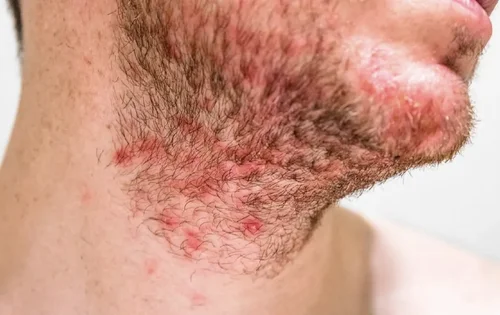
PFB, commonly known as razor bumps, develops when shaved hair curls back into the skin rather than growing outward. For male patients with coarser or curlier hair, this is a recurring problem that shaving worsens over time.
Laser hair removal works by reducing hair growth at the source, which breaks the cycle that causes ingrown hairs to form. Key points for practitioners:
- Research confirms that laser hair removal is an accepted and clinically effective approach for PFB, typically completed over four to six sessions
- Male patients presenting with PFB are coming in with a skin problem, not a cosmetic request, which changes how the consultation is framed
- PFB is one of the most natural entry points for a broader laser facial hair removal conversation with male patients
Wavelength Selection for the Male Face
The right wavelength depends on the patient's skin tone. Male patients seeking facial laser treatment span the full range of skin types, and coarser facial hair places specific demands on the device.
The Alexandrite and Nd:YAG lasers each serve a distinct patient group:
- Alexandrite laser (755 nm): Best suited for patients with lighter skin tones. Works well on hair along the cheeks or beard border in lighter-skinned patients.
- Nd:YAG laser (1064 nm): The preferred option for patients with darker skin tones. Reaches deeper into the skin and is the wavelength of choice for PFB treatment in patients with more skin pigment.
Dual-wavelength capability is the strongest position for practices treating a diverse male patient base, as it removes the need to refer patients out based on skin type. Most male patients need multiple sessions spaced several weeks apart, and setting that expectation at the first consultation is one of the most reliable ways to support long-term retention.
Marketing Laser Facial Hair Removal to Male Patients
Reaching male patients requires a different approach from the one practices typically use for their female patient base. Male patients face distinct barriers to booking aesthetic treatments, including stigma, fear of judgment, and a perception that the aesthetics industry is not built for them. Building a male-oriented presence, rather than simply broadening existing messaging, is what closes that gap.
A few things that make a real difference when marketing to this patient group:
- Talk about the problem first. Men are not searching for "facial laser hair removal" the way female patients might search for a facial treatment. They are searching for a fix to razor bumps, constant neck irritation, or time lost to daily shaving. Your messaging should meet them there.
- Say what the treatment actually does. How many sessions, what it feels like, how long recovery takes. Men who are new to aesthetic treatments want that information upfront, not buried in fine print.
- Show male patients in your before-and-after content. A man looking at your website who sees only female patients in your gallery will assume the service is not for him. Representation in your content does more work than most practices realize.
- Make sure your front desk can answer basic questions about male treatments. If a male patient calls and the person answering cannot speak to his concerns, he will not book.
Male patients research treatments independently before they book. A clear, informational web presence that answers their questions upfront is one of the most practical steps a practice can take to convert this patient group.
Treating Male Facial Hair With Confidence: The Gentle Pro Series Advantage
The Gentle Pro Series from Candela is built to treat the full range of skin types that male patients present with, across all facial treatment areas.
The GentleMax Pro and GentleMax Pro Plus are the core platforms for male facial hair removal, with two laser wavelengths in a single device. A lighter-skinned patient coming in for beard-line cleanup and a darker-skinned patient presenting with PFB on the neck can both be treated in the same practice, without switching equipment. Key patient benefits include:
- Treatments suited to all skin types, including patients with darker skin tones who have historically been underserved
- FDA-cleared for permanent hair reduction and PFB, covering the two most common clinical scenarios in male facial laser hair removal
- Built-in cooling that keeps patients comfortable throughout the session, which matters especially for male patients who are new to aesthetic treatments
- Fast treatment times with the GentleMax Pro Plus, which features the GLX Delivery System for up to 21% faster treatments and 81% faster workflow compared to GentleMax Pro
For practices building out their offering, the GentleLase Pro and GentleYag Pro offer single-wavelength entry points that can be upgraded over time. All Gentle Pro Series treatments can be performed by trained clinical staff, supporting consistent results and a smooth patient experience as your male patient volume grows.
Conclusion: Position Your Practice Before the Demand Passes You By
Male patients seeking laser facial hair removal are not waiting for the aesthetics industry to catch up. They are actively searching for practices that can treat them well, speak to their concerns directly, and deliver results that hold. The clinical opportunity is clear, the device capability exists, and the patient demand is present now.
Practices that address the male patient with the right clinical setup and the right messaging are building a patient base that returns for multiple sessions and often expands into other treatments over time.
To learn more about how the Gentle Pro Series can support laser facial hair removal for male patients in your practice, contact a Candela product expert.
Frequently Asked Questions
How do male patients typically respond to facial laser hair removal in terms of comfort and downtime?
Male patients generally do well with facial laser hair removal. Some redness or mild sensitivity after the session is normal and usually clears within a few hours. There is no recovery period. Patients go back to their day right after.
How should practitioners approach the male patient consultation differently from female patients?
The biggest difference is starting from scratch with education. Many male patients have never had an aesthetic treatment before and do not know what to expect from a session, a treatment series, or the results. Keeping the language plain and grounding the conversation in practical terms, less shaving, fewer ingrown hairs, a cleaner beard line, moves things forward faster than a traditional aesthetic consultation framing.
Can male patients with active skin conditions in the facial area, such as acne, still be treated?
It depends on the state of the skin at the time of treatment. Active breakouts in the area being treated need to be assessed before starting. Patients who have had acne in the past but are not currently breaking out are generally good candidates. A brief skin assessment at the consultation is the right first step.