 Japan
Japan Korea
Korea China
China

How to Choose a Tattoo Removal Laser Machine for Your Practice
What Works, What You Should Consider
Two generations of tattoo removal laser technology are available today: Q-switched and picosecond. Both are widely used across dermatology clinics, plastic surgery practices, and medical spas. What separates them is not simply performance. It is the range of patients and tattoo types that each can address well.
For practices evaluating which platform to invest in, the most consequential question is not which technology is newer. It is the wavelengths and pulse durations a device covers and whether that coverage matches the ink colors and skin types your patients present with. This piece covers how wavelength selection works, what each technology generation brings to practice, and what to weigh before making that decision.
Key Takeaways
- Wavelength is the primary clinical variable in tattoo removal, determining which ink colors a laser can target and which skin types it can treat.
- Both Q-switched and picosecond lasers are established, FDA-cleared options for tattoo removal, each with a defined clinical profile.
- Ink color, skin tone, tattoo age, and depth all influence treatment planning and the number of sessions a patient will need.
- PicoWay® is the only picosecond laser with four wavelengths FDA-cleared for tattoo removal, including the 730 nm wavelength for difficult blue and green inks.
How Does Laser Tattoo Removal Work?
Every tattoo removal laser works on the same foundational principle. When laser energy is directed at a tattoo, the ink particles in the dermis absorb that energy, causing the particles to shatter into fragments small enough for the body's immune system to dispose of. That clearance happens gradually through the lymphatic system over the weeks between sessions.
Where Q-switched and picosecond lasers differ is in how that fragmentation happens:
- Q-switched lasers deliver pulses measured in nanoseconds, generating heat that breaks ink apart through a photothermal effect
- Picosecond lasers deliver pulses in trillionths of a second, producing a photoacoustic effect where energy hits ink particles so rapidly they shatter under mechanical pressure rather than heat alone
Both approaches fragment ink effectively and carry strong clinical track records. What changes between them are how completely the ink is fragmented per session and how much thermal energy is deposited into the surrounding tissue.
Why Ink Color Is a Clinical Variable
Not all tattoo colors respond the same way to laser treatment. Different pigments absorb different wavelengths of light, so a wavelength that effectively targets black ink may have little effect on green or yellow. Dark-colored inks respond well to available laser wavelengths, while lighter pigments such as yellow are resistant because their absorption peaks fall outside what standard laser systems can target.
Tattoo placement also factors into treatment planning. Professional tattoos are deposited deeper in the dermis than amateur ones, which affects how many sessions are needed and how treatment parameters should be set. Ink density, tattoo age, and location all contribute to how the body responds and clears fragmented particles over time.
Here is how the major ink color categories map to wavelengths:
- Black and dark blue: The most responsive ink types, absorbing broadly across a wide range of wavelengths
- Blue and green: Require wavelengths in the 730 nm to 785 nm range for reliable clearance
- Red, orange, and yellow: Respond best to shorter wavelengths around 532 nm
- White and light pastels: The most resistant across all wavelength categories, regardless of laser type, they typically require a combination of wavelength to treat
A device's wavelength range defines which of these color categories a practice can take on. A single-wavelength system may handle black ink well, but a patient with a multicolored tattoo will require multiple wavelengths for full clearance.
How Skin Type Factors Into Wavelength Selection
Ink color is not the only variable that determines wavelength selection. Skin type matters equally, and for a different reason.
Melanin in the epidermis absorbs laser energy just as tattoo pigment does. In patients with lighter skin tones, the contrast between epidermal melanin and tattoo ink is high enough that the laser can target the ink without significant surface interference. In patients with darker skin tones, that contrast narrows, increasing the risk of surface disruption and pigment changes.
That risk narrows with longer wavelengths:
- Shorter wavelengths, such as 532 nm have higher melanin absorption and carry a greater risk in patients with darker skin tones
- Longer wavelengths, such as 1064 nm, penetrate deeper into the dermis with less surface interaction, making them better suited for Fitzpatrick skin types IV through VI
A practice that sees patients across a range of skin tones needs wavelength options that account for all ranges, not just the lighter skin tones.
Laser Tattoo Removal Technology: Q-Switched and Picosecond Options
Q-switched and picosecond lasers each have a distinct clinical profile due to their pulse duration, energy delivery, and the physical mechanism of pigment destruction. Knowing where one fits better than the other is what makes the equipment decision meaningful.
Q-Switch Laser Tattoo Removal
Q-switched lasers operate in the nanosecond range and have a long track record across dermatology practices, medspas, and aesthetic practices. The technology targets tattoo pigment while minimizing thermal impact on surrounding tissue, and clinical outcomes support its reliability. Patients consistently achieved 60% or higher removal rates across black, blue, and colored inks, with improvement building across sessions.
For practices with a defined patient base and a predictable tattoo profile, Q-switched systems are a practical fit:
- Monochromatic tattoos, particularly black and dark blue
- Patient demographics that skew toward lighter skin tones
- Entry-level tattoo removal programs are building toward broader indications
Picosecond Lasers
Where picosecond technology makes the clearest clinical difference is in cases that push up against the limits of nanosecond systems. The shorter pulse duration produces more complete ink fragmentation per session, and because less thermal energy reaches surrounding tissue, the risk of pigment changes is lower. That distinction matters most in patients with darker skin tones.
These platforms are well-suited for:
- ifficult ink colors, including blues, greens, and multicolored tattoos, resistant to standard wavelength coverage
- Tattoos that have been partially treated elsewhere, where prior sessions may have altered ink particle characteristics and require adjusted wavelength and pulse duration parameters
Sessions typically run 15 to 20 minutes with low downtime.
What to Consider When Adding Tattoo Removal to Your Practice
The right laser for tattoo removal is not the one with the most features. It is the one that fits the patients you will actually see. A few questions help frame that decision:
- Who is your patient population? A practice with a predominantly lighter-skin patient base and a high volume of simple, single-color tattoos has different technology requirements than one serving a diverse demographic with complex or multicolored work. Both scenarios are valid starting points; what matters is that the device covers the wavelengths your patients need.
- What tattoo types will you see most? The range of ink colors your patients present with is the most direct indicator of how many wavelengths your device needs to cover. Black and dark blue ink cases can be handled well by a focused single-wavelength system, while a regular volume of multicolored tattoos makes broader wavelength coverage a clinical necessity rather than a nice-to-have.
- How do you want to position your practice? Practices that want to serve patients across a wide range of skin tones and accept cases other clinics turn away need a platform built for that scope from the start.
- Do you plan to expand beyond tattoo removal? A laser platform that also addresses benign pigmented lesions, acne scars, and wrinkles delivers return on investment across multiple treatment categories, not just a single service line.
How PicoWay® Expands the Range of Tattoo Removal Cases Your Practice Can Take On
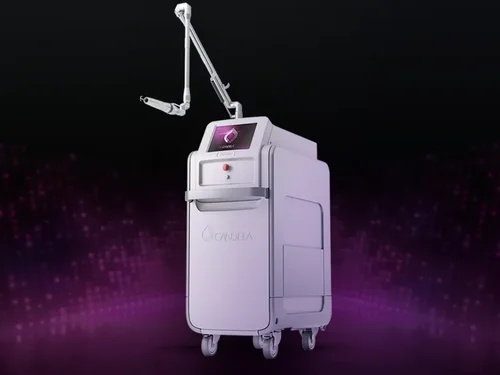
PicoWay is Candela's picosecond laser platform for tattoo removal, and it is the only picosecond laser with four wavelengths FDA-cleared for tattoo removal. Each wavelength targets a specific range of ink colors across different skin types:
- 532 nm: Red, yellow, and orange inks in Fitzpatrick skin types I through III
- 1064 nm: Black, brown, green, blue, and purple inks across all skin types I through VI
- 730 nm: Blue and green inks in skin types II through IV, the first wavelength of its kind offered for this resistant ink range
- 785 nm: Blue and green inks in skin types II through IV
With four wavelengths covering the full ink color spectrum and FDA clearance across all Fitzpatrick skin types for the 1064 nm handpiece, PicoWay is built to handle the cases where wavelength limitations would otherwise be a barrier.
Conclusion: Build Your Tattoo Removal Practice Around the Patients You Want to Serve
Wavelength selection is the clinical decision that everything else in tattoo removal flows from. It determines which ink colors you can target, which skin types you can treat with confidence, and how consistently your patients will see results. The technology generation, Q-switched or picosecond, shapes how that clearance happens. But the wavelength range your device covers defines who walks through your door and what you can do for them.
tattoo removal offering that works for its patient base, not just for the most straightforward cases.
Contact a Candela product expert to find out how PicoWay fits your practice.