 Japan
Japan Korea
Korea China
China

Alexandrite vs Diode Laser
Which Technology Drives Better Results for Your Practice?
When evaluating laser hair removal technology, alexandrite and diode come up in nearly every conversation. Both are well-established, and both can deliver long-term hair reduction when used correctly.
The real question is not which technology is better in isolation. It is which one performs better for your patient population, your treatment volume, and your practice goals. That answer depends on clinical performance across skin types, where speed advantages actually apply, and what the ROI picture looks like over time.
Key Takeaways
- Both alexandrite and diode laser hair removal rely on the same mechanism. Wavelength is what determines which patients each technology serves best.
- Alexandrite delivers fast, precise results on lighter skin tones; diode extends that reach across the Fitzpatrick scale.
- Speed per session is only part of the equation. Treatment workflow and applicator design affect total daily throughput.
- The 755 nm alexandrite wavelength treats beyond hair removal, covering pigmented and vascular lesions that a diode-only setup cannot offer.
How Alexandrite and Diode Lasers Work
Both alexandrite and diode laser hair removal operate on the same foundational principle: selective photothermolysis. The laser emits a beam of light that melanin in the hair follicle absorbs and converts into heat. That heat disrupts the follicle's ability to produce new hair while leaving the surrounding tissue largely unaffected.
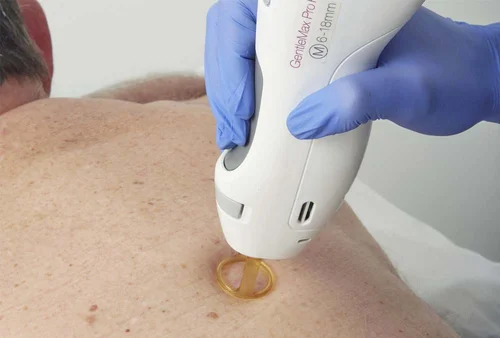
The difference between them starts at the wavelength level, and that difference has meaningful downstream effects on which patients each technology serves best.
Alexandrite Laser Hair Removal (755 nm)
The Alexandrite laser operates at 755 nm, a wavelength with high melanin absorption that targets the hair follicle efficiently in patients with lighter skin tones. The 755 nm wavelength has been utilized clinically for hair removal, vascular lesions, and pigmented lesions because melanin and hemoglobin in the skin selectively absorb it.
- Optimal skin types: Fitzpatrick I through IV (Ideal for I-III)
- Strengths: High-speed treatment coverage, large spot sizes, fast repetition rates, multi-indication capability beyond hair removal
- Limitation: Higher epidermal melanin in Fitzpatrick types IV and above increases the likelihood of pigmentation changes if parameters are not carefully managed
Diode Laser Hair Removal (800 to 810 nm)
Diode lasers operate at 800 to 810 nm, a longer wavelength that penetrates deeper into the dermis with less interaction with surface melanin, making the technology viable across a broader skin type range. Many modern diode systems incorporate in-motion technology, where the handpiece moves continuously across the treatment area, which partially offsets any per-pulse speed disadvantage.
- Optimal skin types: Fitzpatrick I through VI
- Strengths: Broader patient reach, deeper follicular penetration, effective on medium to darker skin tones
- Limitation: Not as powerful; May require more sessions to reach comparable outcomes on some patient profiles; wavelength selection by skin type remains a key clinical variable
Clinical Performance Across Skin Types
The most useful way to evaluate these two technologies is not which one produces better absolute results. When each is matched to the right patient, both deliver strong long-term outcomes. The divergence is in patient eligibility.
Clinical evaluation of the 755 nm alexandrite laser in Fitzpatrick types II and III found that 85% of participants rated their improvement as very good following three treatment sessions, with results sustained at both 6 and 12 months. Diode achieves consistent outcomes across a wider range of skin types, with its longer wavelength and deeper penetration making it suitable for patients where alexandrite's high melanin absorption would be a concern.
| Factor | Alexandrite | Diode |
| Wavelength | 755 nm | 800 - 810 nm |
| Melanin absorption | High | Moderate |
| Penetration depth | Moderate | Deeper |
| Optimal skin types | Fitzpatrick I to III | Fitzpatrick I to VI |
| Indications beyond hair removal | Benign pigmented lesions, vascular lesions | Hair removal, benign pigmented lesions |
Speed, Patient Reach, and Practice ROI
Speed and ROI are connected, but neither tells the full story on its own. The stronger investment decision accounts for treatment throughput, patient demographic reach, and the range of indications a device can support.
Treatment Speed
- Alexandrite's high repetition rates and large spot sizes cover large body areas quickly on Fitzpatrick I through IV patients with dark coarse hair
- That speed advantage is patient-dependent and does not extend across the full skin type range
- Diode systems with in-motion technology enable continuous handpiece movement, partially offsetting the per-pulse speed difference
- Applicator changes mid-session add time regardless of pulse speed, making system workflow a factor beyond raw speed alone
Patient Reach and ROI
- Per-session speed matters less than total patient throughput across a diverse patient base
- Alexandrite's skin type limitation directly affects bookable appointment volume in markets with diverse patient demographics
- Diode's broader skin type compatibility supports a wider patient pool, which has a direct impact on revenue potential
- The 755 nm alexandrite wavelength supports additional indications, including benign pigmented lesions and vascular treatments, creating revenue beyond hair removal that a diode-only setup does not offer
- The global laser hair removal market was estimated at USD 1.09 billion in 2023 and is projected to reach USD 3.6 billion by 2030, growing at a CAGR of 18.8%
- A boutique clinic with a defined lighter-skin patient base may find standalone alexandrite sufficient; a high-volume or diverse practice benefits from broader skin type coverage and expanded indications
What GentleMax Pro Plus® Brings to Your Practice
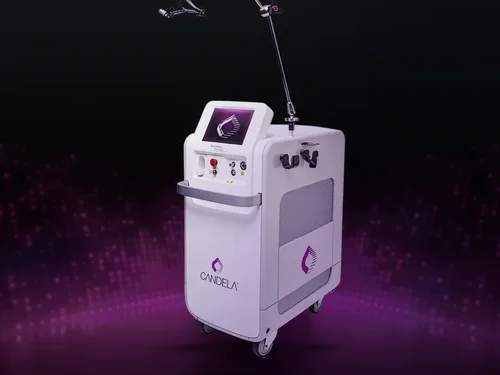
GentleMax Pro Plus® is Candela's premier alexandrite laser hair removal device, combining 755 nm alexandrite and 1064 nm Nd:YAG in a single platform. The dual-wavelength design covers the full Fitzpatrick spectrum, from lighter skin types, where alexandrite excels, to darker skin types, where the 1064 nm Nd:YAG takes over.
- GLX™ Delivery System: Up to 21% faster treatment time and up to 81% faster treatment workflow compared to GentleMax Pro® treatments, with a single applicator covering spot sizes from 12 to 26 mm
- Spot size range: 1.5 to 26 mm, with a 2 ms pulse duration for fine hair treatment
- DCD™ cooling: Operator-independent cryogen burst with each pulse, scaling automatically with treatment parameters
- FDA-cleared indications: Permanent hair reduction across all skin types, benign pigmented lesions, vascular lesions, spider and leg veins, wrinkles, diffuse redness, port wine stains, pseudofolliculitis barbae, and onychomycosis
- Proven at scale: Over 25 years of clinical use, 20,000 devices installed, presence in 89 countries
For practices at earlier stages, the Gentle Pro Series includes single-wavelength options such as the GentleLase Pro® (755 nm), with upgrade pathways as the practice grows.
Conclusion: Choose the Technology That Serves Your Full Patient Base
Neither alexandrite nor diode is the universal answer. The right choice depends on who your patients are, how much volume your practice handles, and what you need a single device investment to do.
For practices with a well-defined lighter-skin patient base, standalone alexandrite delivers proven clinical performance. For practices with a diverse or growing patient population, broader skin type coverage and expanded indications translate to stronger long-term ROI.
GentleMax Pro Plus delivers alexandrite-level precision and speed alongside full skin type coverage and a wide FDA-cleared indication range in one platform. It is built for practices that do not want to choose between clinical performance and patient reach.
Speak with a Candela product expert to see how GentleMax Pro Plus fits your practice.
Frequently Asked Questions
How do I decide which technology is right for my current patient base?
Start with your patient demographics. If your practice serves predominantly lighter skin patients , a standalone alexandrite platform delivers proven clinical performance and fast treatment times. If your patient base is mixed or you are in a diverse market, a dual-wavelength system that covers the full Fitzpatrick spectrum protects your revenue potential and reduces the likelihood of turning patients away. Practices looking to grow beyond their current patient profile benefit most from a platform that does not require them to choose a lane.
Can I upgrade from a single-wavelength alexandrite system to a dual-wavelength platform?
Yes. The Gentle Pro Series is designed with upgrade pathways in mind. The GentleLase Pro (755 nm) is a strong entry point for practices focused on lighter skin types, and can be upgraded to add 1064 nm Nd:YAG capability as the practice grows. The GLX™ Delivery System is also available as an upgrade to existing GentleMax Pro Plus devices, allowing practices to add the fastest treatment workflow in the series without replacing the full system.
Does the Alexandrite laser treat anything beyond hair removal?
Yes. The 755 nm wavelength targets both melanin and hemoglobin, which supports treatment of wrinkles, benign pigmented lesions, and vascular lesions in addition to hair removal. On the GentleMax Pro Plus, the 1064 nm Nd:YAG extends that indication range further to include spider and leg veins, wrinkles, diffuse redness, port wine stains, pseudofolliculitis barbae, and onychomycosis. This breadth means a single device investment supports multiple revenue-generating services across your treatment menu.
*Individual results may vary. Treatment considerations are under the discretion of the qualified licensed healthcare professional.