 Japan
Japan Korea
Korea China
China

Treating Vascular Conditions with Pulsed Dye Laser (PDL)
Vascular skin conditions rarely come with a simple fix. Rosacea persists through seasons and topical routines. Port wine stains deepen without intervention. Spider veins reappear. Hemangiomas require careful monitoring from early infancy. What connects all of them is that patients are actively looking for answers, and many have already exhausted what over-the-counter products can offer.
Pulsed dye laser treatment has been the clinical standard for this category of conditions for over three decades. This article covers how it works, which conditions it addresses, and what to look for when evaluating it for your practice.
Key Takeaways
- At 595 nm, pulsed dye laser light is absorbed by hemoglobin in blood vessels, coagulating them while the surrounding skin is largely spared.
- Rosacea, port wine stains, hemangiomas, facial telangiectasia, and spider veins all fall within PDL's recognized indications.
- Pulse durations are adjustable, giving providers control over how the laser interacts with vessels of different sizes and depths.
What Is Pulsed Dye Laser Treatment?
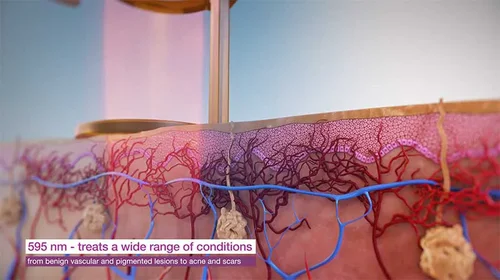
PDL is a laser that emits light at 595 nm, a wavelength blood vessels absorb at a much higher rate than the surrounding skin. That difference in absorption is the whole point. When the energy reaches the vessel, hemoglobin converts it to heat, the vessel wall coagulates, and the lesion clears. The skin around it absorbs comparatively little of that energy, which is why the approach can be precise without damaging adjacent tissue.
This is the principle of selective photothermolysis. The key variables practitioners work with are:
- Wavelength: 595 nm for superficial vessels; 1064 nm Nd:YAG, on select platforms, for deeper blue veins
- Pulse duration: Adjustable from 0.45 to 40 milliseconds, matched to vessel size and depth
- Spot size: Varied to cover larger areas or isolate smaller, discrete lesions
- Cooling: Cryogen-based cooling protects the skin surface during each pulse
Across patients treated for vascular lesions and scars, 70.4% achieved excellent clearance outcomes. The pulse duration range is what keeps PDL from being a one-size tool: a setting appropriate for a fine facial capillary would not be appropriate for a deeper leg vein.
Which Vascular Conditions Does PDL Treat?
PDL carries FDA clearance across a wide range of vascular and dermatologic indications. For practices building or expanding a vascular service line, the breadth matters.
Rosacea and Facial Redness
PDL was originally developed to treat benign vascular lesions. It was first introduced for the treatment of port wine stains (PWS) in children. That same vascular-targeting technology makes it highly effective for the vascular component of rosacea, including chronic redness, visible capillaries, and flushing. Patients dealing with this presentation often describe how much it affects their day-to-day confidence, and many have tried topical options without meaningful improvement. PDL coagulates the dilated vessels underneath, reducing erythema and telangiectasia at the source.
Greater than 50% clearance was reported in up to 68.6% of PDL-treated rosacea cases across pooled research. With rosacea affecting an estimated 5.1% of adults globally, many of whom remain undertreated, the patient population is both large and consistent.
Port Wine Stains
Port wine stains are congenital vascular birthmarks that affect approximately 1 in every 300 infants. Left untreated, they darken and thicken over time, making them harder to clear. PDL is the recognized standard of care for this indication globally. Younger patients tend to respond better, since the vessel architecture is simpler, melanin competition is lower, and the lesion has not yet undergone the thickening that complicates adult treatment.
Infantile Hemangiomas
Hemangiomas are benign vascular growths that show up shortly after birth and grow fast in the first months of life. PDL is used to stop that growth, shrink the lesion, and support its natural regression. Across a broad body of pediatric research, PDL has been confirmed as a well-established treatment for both port wine birthmarks and infantile hemangiomas, following the June 2023 FDA clearance for use from birth through age 21.
Spider Veins and Facial Vessels
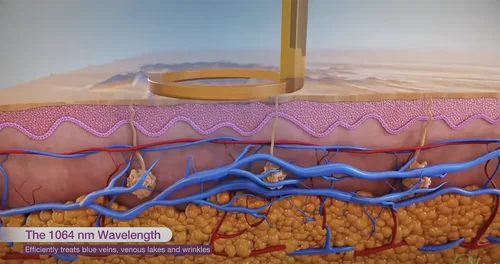
Fine spider veins on the face and legs are among the most frequently requested cosmetic treatments in any aesthetic setting. The 595 nm wavelength handles superficial facial vessels and broken capillaries well. Platforms with the 1064 nm option extend reach to deeper blue veins without adding a separate device.
Scars, Warts, and Other Indications
Beyond vascular lesions, PDL carries clearance for hypertrophic scars, striae, psoriasis, warts, and inflammatory acne vulgaris. For scar tissue specifically, the laser reduces the blood supply feeding the scar and sets off collagen remodeling. Keloids and hypertrophic scars have shown measurable response through this mechanism, with capillary breakdown altering the collagen activity that drives abnormal scar formation.
How to Choose the Right PDL Device for Your Practice
The platform matters as much as the technology behind it. A few considerations worth evaluating:
- Wavelength options. The 595 nm wavelength handles most core vascular indications well on its own. Adding 1064 nm expands reach to deeper vessels and wrinkles without a second system.
- Skin type compatibility. Consistent epidermal protection across skin tones depends on the cooling system, not just the wavelength. A platform that scales cooling automatically with treatment parameters removes one variable from the equation.
- Pediatric clearance. Not every vascular laser is cleared for use in children. For practices treating birthmarks or hemangiomas in pediatric patients, this distinction is not optional.
- Indication range. A platform cleared for a wider range of indications gives providers more room to address multiple concerns in the same patient, something that affects both treatment efficiency and patient retention.
- Workflow fit. How quickly staff can move between patient profiles depends on the interface, preset options, and the ergonomics of the delivery system. This matters more the higher the patient volume.
Precision Across Every Vascular Indication with beam by Candela
The Vbeam® is Candela's PDL platform, trusted in over 670 hospitals and universities across 23 countries. It carries 45 FDA-cleared indications across all Fitzpatrick skin types and has a well-established clinical reputation as the gold standard for vascular laser treatment.
At 595 nm, the Vbeam targets hemoglobin in blood vessels, generating enough heat to coagulate and close them while the skin surface stays protected. The Dynamic Cooling Device (DCD) sprays a brief burst of cryogen with each pulse, protecting the epidermis automatically without requiring manual adjustment between patients.
The Vbeam Pro adds 1064 nm for deeper vascular work, including blue leg veins, venous lakes, and wrinkles. It stores up to 18 custom treatment settings in guided mode, which reduces time spent reconfiguring between indications. Most patients see results after one session, with rosacea and recurring vascular concerns typically returning for maintenance over time.
Conclusion: Add PDL Treatment to Your Practice With the Right Platform Behind It
Pulsed dye laser treatment covers some of the most consistently requested vascular concerns in aesthetic and dermatologic care. The clinical evidence positions it as the first-line option across rosacea, port wine stains, hemangiomas, spider veins, and several non-vascular indications. The demand is steady. The category is well established.
Contact a Candela product expert to learn how the Vbeam fits your patient population and what it can bring to your treatment menu.
Frequently Asked Questions
What is pulsed dye laser treatment used for?
PDL is FDA-cleared for rosacea, facial telangiectasia, port wine stains, hemangiomas, spider veins, hypertrophic scars, striae, warts, psoriasis, and inflammatory acne vulgaris. Select platforms extend that to deeper blue veins and wrinkles through a 1064 nm wavelength.
How does PDL differ from other vascular lasers?
The 595 nm wavelength is absorbed at a much higher rate by hemoglobin than by the surrounding skin. That selectivity is what allows the energy to reach and close the target vessel without affecting adjacent tissue, which is why PDL remains the recognized standard for conditions like port wine stains and rosacea.
Is pulsed dye laser treatment suitable for all skin types?
With the right platform and cooling system, yes. Cryogen-based cooling shields the skin surface during treatment, which matters most for patients with higher melanin levels where thermal competition is a real concern. The 1064 nm wavelength on select platforms adds flexibility for deeper indications across a broader range of skin tones.