 Japan
Japan Korea
Korea China
China

Best Treatment for Acne Scars and Skin Texture
For many patients, clearing their acne is only half the battle. What stays behind is often harder to address than the breakouts themselves. They have researched treatments, read reviews, and arrived at the consultation with specific questions about what will actually work.
Choosing the best treatment for acne scars is less about picking a single technology and more about building a protocol that accounts for what the patient's skin needs.
Key Takeaways
- Acne scars present across three categories: atrophic, hypertrophic, and post-inflammatory pigmentation, and each requires a different clinical approach.
- No single treatment works across every scar type. Protocols matched to scar morphology and skin tone consistently deliver better outcomes.
- Skin tone shapes modality selection. RF-based treatments work independently of skin pigment, making them a suitable option across a broader range of Fitzpatrick skin types.
- Candela's Matrix and PicoWay systems allow practices to address both the structural and pigmentary dimensions of acne scarring and skin texture with two platforms.
Why Acne Scarring Is Harder to Treat Than It Looks
Acne scarring is one of the more persistent consequences of inflammatory acne. Unlike surface discoloration, it involves actual changes to the dermal structure that no over-the-counter product can reach.
Types of Acne Scars
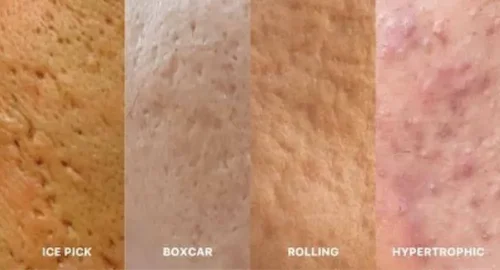
Not all acne scars behave the same way, and that distinction drives every treatment decision. Roughly 90% of patients with acne scarring present with atrophic scars, the depressed kind that form when the skin does not produce enough collagen during healing. Hypertrophic and keloid scars go the other direction, forming raised tissue when the body overproduces fibrotic connective tissue. Post-inflammatory hyperpigmentation is in a category of its own. It is not a true scar but a consequence of the inflammatory response that occurs during the healing process, and it frequently appears alongside structural scarring.
Atrophic (depressed) scars:
- Ice pick scars: Narrow and deep, extending well into the dermis. These are the hardest to treat and rarely respond to resurfacing alone. Most practitioners layer in additional approaches.
- Boxcar scars: Wider than ice pick scars, with clearly defined edges and a flat base. They tend to respond well to energy-based resurfacing and are generally more straightforward to treat.
- Rolling scars: Give the skin a wavy, uneven texture caused by fibrous bands pulling the surface downward from beneath. Releasing that tethering before resurfacing tends to improve how well the treatment lands.
Hypertrophic and keloid (raised) scars:
- Hypertrophic scars: Raised but contained within the original wound boundary. They show up more often on the chest, back, and shoulders than on the face.
- Keloid scars: Similar in appearance but extend past the original site. More prevalent in patients with darker skin tones, and they call for a different treatment path than atrophic scarring.
Post-inflammatory hyperpigmentation (not a true scar):
- Post-inflammatory hyperpigmentation (PIH) and post-inflammatory erythema (PIE): The flat dark or red marks left behind after a breakout heals. They fade over time without structural intervention, but patients often present with them alongside true scars, and the two need to be addressed differently.
Most patients arrive with a mix of these. What type, where, and in what combination is what shapes the protocol.
What Is the Best Treatment for Acne Scars
The short answer is that there is no single one. Research consistently points to the same conclusion: no single modality universally suffices, and treatment strategies need to be matched to the patient's specific scar morphology and skin tone to produce reliable outcomes.
Modality selection follows from that framework:
- RF microneedling produces comparable improvements to fractional CO2 laser for rolling and boxcar scars, with a favorable tolerability profile supported by direct head-to-head trials
- Ablative fractional lasers achieve strong results for certain scar subtypes but are not the right fit for every patient presentation or skin tone
- In patients with darker skin tones, post-inflammatory hyperpigmentation is a well-documented outcome following fractional CO2 laser resurfacing, which directly affects which modality belongs in the protocol
- RF-based modalities work independently of skin pigment, making them a more predictable option across a broader range of Fitzpatrick skin types
For practices looking to go deeper on laser modality selection, the Candela blog on energy-based treatments for acne scars covers the resurfacing technology landscape in detail.
Building a Protocol Around the Patient, Not the Device
Technology selection should be the output of a structured consultation, not the starting point. Three variables shape every protocol decision:
- Start with scar classification. Identify which subtypes are present and how deep the most significant ones appear before any device discussion begins. Ice pick scars and boxcar scars on the same face do not call for the same approach.
- Account for skin tone before selecting a modality. Fitzpatrick skin type shapes the outcome profile of every resurfacing option. For patients with skin types IV to VI, RF-based modalities offer a more predictable result while still delivering clinically meaningful collagen remodeling.
- Set the series before the first session. Acne scar treatment is not a single-appointment outcome. Most protocols run three to four sessions, and collagen remodeling continues for months after the final one. Patients who understand this at the start are more likely to complete the series and report satisfaction.
How Candela Addresses Acne Scarring in Clinical Practice
Candela's Matrix™ and PicoWay® systems cover two presentations that frequently appear together in acne scar patients looking for improvements in skin texture: structural scarring and pigmentation-related scarring.
Matrix brings three RF-based applicators into one platform, each working at a different layer of the skin. Because RF energy works independently of skin pigment, Matrix is indicated for use across all Fitzpatrick skin types.
- Matrix Pro delivers RF energy through ultra-thin microneedles at up to three depths in a single insertion, stimulating collagen remodeling from within
- Sublative uses fractional RF delivered in a matrix pattern to resurface the skin with minimal surface disruption and little to no downtime
- Sublime takes a fully non-invasive approach, combining infrared light and bipolar RF for wrinkle reduction and skin tightening with no needles involved
PicoWay is well-suited for patients where post-inflammatory pigmentation accompanies structural scarring. The Resolve 1064 nm handpiece delivers ultra-short picosecond pulses beneath the skin surface to stimulate new collagen and elastin without disrupting the outer layer. Sessions run 15 to 20 minutes with low to no downtime, and the handpiece is FDA-cleared for acne scars in Fitzpatrick skin types II through V.
Together, the two platforms allow a practice to address the structural and pigmentary dimensions of acne scarring and skin texture without adding devices.
Conclusion: Turn Acne Scar Consultations Into Confident Treatment Plans
Acne scar patients seeking improvements in overall skin texture are already in the consultation room. The practices that retain them are the ones with a clear enough framework to walk them through a protocol that matches their skin. That means classifying the scar before selecting the technology, accounting for skin tone before committing to a modality, and setting the full treatment series as an expectation from the first appointment.
Candela's Matrix and PicoWay systems give practices the range to treat structural scarring, textural irregularities, and pigmentation-related concerns across the Fitzpatrick spectrum with two platforms rather than many.
Contact a Candela product expert to learn how Matrix and PicoWay can fit into your acne scar protocol.
Frequently Asked Questions
Is it appropriate to treat acne scars while a patient still has active breakouts?
Active acne and acne scarring are treated as separate phases. Most practitioners wait until breakouts are controlled before starting a scar series. Treating over active lesions can worsen inflammation and affect outcomes. Once a patient's skin is stable, scar treatment can begin.
How should practitioners manage expectations when multiple scar types appear on the same face?
The honest answer is that different subtypes respond at different rates, and ice pick scars in particular tend to move slowly compared to rolling or boxcar scars. Being upfront about that at the first consultation, naming which areas are likely to show improvement earlier and which may take longer, goes a long way toward keeping patients engaged through the full series. When patients understand that results build session by session rather than appearing all at once, they are far less likely to drop off mid-treatment.
Can treatments be combined with other in-office procedures in the same session?
Often yes, depending on what is on the treatment plan and the patient's skin at that visit. RF microneedling and picosecond laser are both commonly paired with other in-office services, and Matrix's treatment stacking capability means multiple applicators can be used in a single appointment without needing to schedule separately. The right combination is always a clinical call based on the modalities involved and where the patient is in their series.