 Japan
Japan Korea
Korea China
China

Non-Surgical Facial Contouring in Aesthetic Practice
Technologies, Indications, and Clinical Considerations
From dermal fillers and thread lifts to energy-based devices and cupping-based facial treatments, non-surgical procedures for face contouring now span a wide range of technologies, each targeting different facial features and tissue layers and suited to a different patient profile. Facial contouring surgery has long been the reference point for structural change, but the non-surgical options that have developed alongside it give practitioners more pathways for patients who want meaningful results without surgical intervention or extended recovery.
The question practitioners are navigating is not whether to offer facial contouring but which approach belongs in their service menu and for which patients. With multiple technologies available, each with a distinct mechanism and depth of action, matching the right treatment to the right concern requires a clear clinical framework.
Key Takeaways
- Facial contouring is not a single treatment category but a spectrum of outcomes spanning structural volume, tissue laxity, and surface-level definition.
- Structural concerns such as volume loss, facial hollowing, and jawline laxity require technologies that reach deeper tissue layers.
- Surface-level concerns such as puffiness and reduced skin firmness respond to approaches that work at the skin surface.
- Four non-surgical technology categories are available: injectables and biostimulators, thread lifts, energy-based devices, and surface-level mechanical approaches.
The Growing Patient Demand for Non-Surgical Facial Contouring
More patients are walking into consultations with a clear ask: sharper jawlines, fuller cheeks, better definition, and no surgery. Facial skin tightening ranks as the top application area in a market projected to grow from USD 3.24 billion in 2024 to USD 12.34 billion by 2034. Patients are arriving informed, with specific outcome expectations, which places greater demand on practices to have the right technologies in place.
What Facial Contouring Addresses
Facial contouring covers a range of patient concerns that fall into two broad categories, each requiring a different clinical approach:
Structural contouring concerns
- Volume loss in the cheeks, mid-face, and temples
- Tissue laxity along the jawline and neck
- Submental fullness and loss of chin definition
- Facial hollowing in the periorbital and malar regions
Surface-level definition concerns
- Reduced skin firmness and tone affecting the visible appearance of definition
- Puffiness and fluid retention masking natural contours
- Skin texture and quality diminishing the overall sculpted appearance
Structural concerns call for technologies that reach deeper tissue. Surface-level concerns respond to approaches at or near the skin surface. Getting this distinction right is where treatment selection either succeeds or falls short.
Non-Surgical Facial Contouring Technology Categories
Non-surgical facial contouring encompasses several distinct technology categories, each working at a different tissue level and suited to different patient presentations.
Injectables and Biostimulators
- Hyaluronic acid (HA) fillers: Directly restore lost volume in the cheeks, mid-face, and jawline with immediate visible results; reversible with hyaluronidase if needed
- Neuromodulators (botulinum toxin): Relax overactive facial muscles to soften dynamic lines and improve lower face definition
- Poly-L-lactic acid (PLLA): Stimulates the body's own collagen over several months, gradually improving skin thickness and facial structure
- Calcium hydroxyapatite (CaHA): A thicker biostimulator suited to deeper volumization and structural support in the cheeks and jawline
Where volume loss or soft tissue deflation is the primary driver, this category offers the most direct path to a visible result. HA fillers work in a single appointment; patient satisfaction in midface augmentation is well-documented, and biostimulators extend the benefit through collagen induction over the months that follow.
Thread Lifts and Minimally Invasive Lifting
- PDO (polydioxanone) threads: The most widely used option; barbed threads lift and reposition tissue, smooth threads stimulate collagen without a mechanical pull
- PCL (polycaprolactone) threads: Slower to absorb than PDO, providing a longer window of tissue support and collagen stimulation
- PLLA threads: Prioritize biostimulatory collagen induction alongside the mechanical lift
What makes thread lifts clinically useful is the gap they fill between injectables and a surgical facelift. Barbed threads anchor tissue immediately, and as the material breaks down through hydrolysis over several months, new collagen forms around the insertion points. Placement follows facial anatomy closely, which is why practitioner training and anatomical knowledge are particularly important with this category. Recovery is short, typically a few days of mild tenderness.
Energy-Based Devices
- RF microneedling: Microneedles carry radiofrequency energy into the dermis at controlled depths, driving collagen remodeling and tissue contraction from within
- Monopolar and bipolar RF: Non-invasive delivery of radiofrequency heat to the dermis, suited to surface firming and early laxity
- HIFU: Focused ultrasound energy reaches the SMAS layer, producing a lifting effect at a depth that surface RF does not access
Of the energy-based options, RF microneedling and HIFU have the strongest data for facial contouring outcomes. Radiofrequency technology in microneedling has demonstrated volume reductions along the jawline and volume increases in the midface as collagen rebuilds. HIFU, across a systematic review of 45 trials, showed laxity improvements of 18% to 30% in the lower face and neck. Both take three to six months to show their full effect.
Surface-Level and Mechanical Approaches
- Cupping massage: Vacuum-based suction that moves lymphatic fluid and reduces puffiness masking natural facial contours
- Lymphatic sculpting: Manual or device-assisted drainage that clears fluid retention and restores visible jawline and cheek definition
- Device-assisted surface treatments: Combine mechanical stimulation, exfoliation, and serum infusion to improve skin quality and surface-level definition
Not every contouring concern requires a device that penetrates tissue. For patients whose primary issue is fluid retention or surface definition rather than structural laxity, these approaches address exactly what deeper technologies are not designed to reach.
Selecting the Right Approach for Each Patient Concern
The presenting concern determines which category of technology is appropriate. For structural concerns:
- Volume loss and facial hollowing: Injectables restore volume immediately; energy-based devices build it back over time through collagen remodeling
- Tissue laxity along the jawline and neck: Both energy-based devices and thread lifts address laxity, with threads offering a more immediate mechanical result
- Submental fullness and double chin: Energy-based devices that reach subcutaneous tissue are the primary non-surgical option for reducing submental fat and improving chin definition
For surface-level concerns, cupping massage, lymphatic sculpting, and device-assisted surface treatments address the definition issues that deeper technologies are not designed to target. When both concern types are present, combination protocols are a practical and increasingly standard approach.
Putting It Into Practice: Candela's Facial Contouring Approach
For practices looking to address facial contouring across both tissue levels, Candela offers two platforms that work together within a single treatment environment.
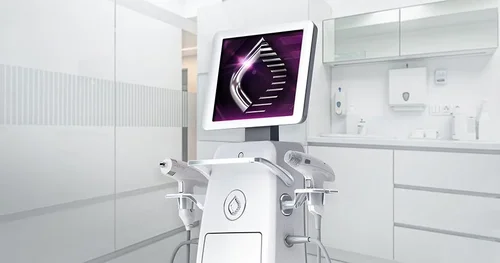
The Matrix™ system is an FDA-cleared, CE-marked, and TGA-cleared skin renewal platform built for structural facial contouring. RF energy is delivered at up to three tissue depths in a single session, with real-time impedance monitoring adjusting output continuously to account for variation across skin layers.
Matrix is used for*:
- Volume loss and facial hollowing
- Neck and submental fullness
- Jawline definition and loose skin
- Early signs of laxity through more advanced structural changes
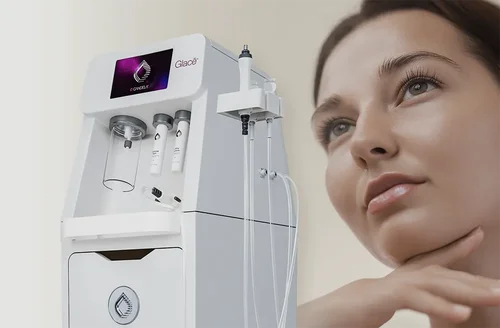
Glacē™ addresses surface-level definition concerns through its dual-mode cupping massage. Pulsed mode supports lymphatic flow and reduces the appearance of puffiness; continuous mode supports the appearance of sculpted features, lifted cheeks, and a more defined jawline. Glacē works as a standalone facial treatment or alongside energy-based procedures.
Used together, Matrix and Glacē give practices a complete response to the full range of facial contouring concerns patients bring to the consultation, without requiring multiple separate platforms or workflows.
Conclusion: Build a Facial Contouring Offering That Matches Every Patient
Non-surgical facial contouring spans structural and surface-level concerns, and the right technology follows the patient's presenting need. Many patients bring both to the consultation, which is why combination protocols across tissue levels have become standard practice.
Candela's Matrix and Glacē systems give practices the tools to address that full range within a single treatment environment. To learn how they can support your facial contouring offering, contact a Candela product expert today.
Frequently Asked Questions
Can non-surgical facial contouring results be maintained long-term?
Results vary by technology and patient profile. Most treatments require an initial series followed by periodic maintenance, typically annually or biannually, to sustain outcomes as tissue continues to change over time.
How do I determine the right approach for a patient who is not a candidate for injectables?
Start with the presenting concern. For structural issues such as volume loss or jawline laxity, energy-based devices and thread lifts are both viable paths. For surface-level concerns, mechanical approaches work well independently of injectables.
Can energy-based contouring treatments be combined with injectables in the same treatment plan?
Combination protocols are common in practice. Appointments are typically spaced to allow tissue recovery, with sequencing determined by the practitioner based on clinical judgment.